
What Actually Causes Gelcoat Oxidation (And What Stops It)
Oxidation isn't dirt and it doesn't wash off. What's actually happening to your gelcoat, why it accelerates, and what genuinely slows it down.
Every spring somebody asks me why their hull went chalky over one season when the boat next to theirs didn't. It's usually the same three or four causes, and only one of them is really about how often you wash it.
Oxidation isn't dirt. You can't clean it off, because it isn't sitting on the surface — it's the surface, breaking down.
What oxidation actually is
Gelcoat is a polyester resin with pigment in it. UV radiation breaks the chemical bonds in that resin at the surface. As those bonds fail, the pigment loses its binder and the surface goes porous and microscopically rough.
That roughness is what you're seeing. Light hits an uneven surface and scatters instead of reflecting, so the color reads chalky and flat. Rub your hand on a badly oxidized hull and you'll come away with pigment on your palm — that's gelcoat that has already failed.
It is not reversible. Compounding removes the failed layer to expose sound resin underneath. It doesn't repair anything.
What accelerates it
Sun, obviously — but it's about hours, not intensity. A boat on a mooring all season takes far more UV than one under cover, and the difference compounds year over year. Southern exposure on a hull side matters more than most owners think.
Salt. Dried salt is hygroscopic — it holds moisture against the surface and stays there through heat cycles. It also scratches when you wipe it off dry.
Heat cycling. A dark hull in direct sun can run 40–50 degrees above ambient, then drop overnight. That expansion and contraction, repeated all season, works the failing surface open faster.
Dark and metallic colors. More heat absorbed, more visible degradation per unit of damage. A white hull hides early oxidation for years. A navy hull shows it in one bad season.
Aggressive cleaning. Acid hull cleaners and abrasive compounds strip oxidation by removing gelcoat. Used often enough they cause the problem they're solving.
What doesn't stop it
Wax. Weeks to a couple months. It's a sacrificial layer and it's mostly gone by midsummer.
Ceramic coating. Genuinely slows oxidation — it's a harder, more UV-resistant layer than wax and it lasts far longer. But it's measured in microns and it degrades. It's a delay, not a stop, and it does nothing for physical damage.
Compounding and polishing. This removes oxidation that already happened. It also removes gelcoat, permanently, every time. There's a finite number of passes in any hull and nobody tells you which one was the last safe one.
What actually stops it
Blocking the UV from reaching the gelcoat at all.
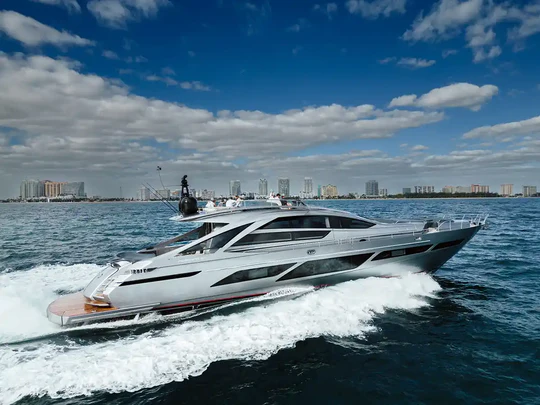
Marine protection film is a urethane layer applied over the finish that absorbs UV before it gets to the resin underneath. The gelcoat under film isn't slowly oxidizing more slowly — it's substantially out of the process. It also takes the dock rash and abrasion that would otherwise mark the surface.
Yacht Armor publishes a service life of 5 to 7 years for the film with proper maintenance, and guarantees it for three years from installation.
The limitation is honest: film goes on the surfaces you apply it to. Everything else on the boat still oxidizes at whatever rate it was already going to.
If your gelcoat is already gone
Film goes over the finish you have. If the hull is already chalky, filming it locks in a dull surface.
The sequence is: correct it once, properly, then protect it. That's a detailer's job first and mine second. I'll tell you at the inspection which situation you're in.
Oxidation is a chemical process with a specific cause. Wax delays it slightly, coatings delay it meaningfully, and film largely takes the surface out of the equation. What none of them do is reverse it — which is the argument for doing something before the hull looks bad rather than after.
Want to talk through what makes sense for your boat?
I look at every vessel in person before saying anything specific. Call and we'll set up a time.
Call (978) 543-5274